
Helion Achieves New Industry-First Fusion Energy Milestones, Accelerating Path to Commercial Fusion
Polaris becomes first privately funded fusion energy machine to operate with deuterium-tritium fuel, sets record with plasma temperatures of 150 million degrees Celsius
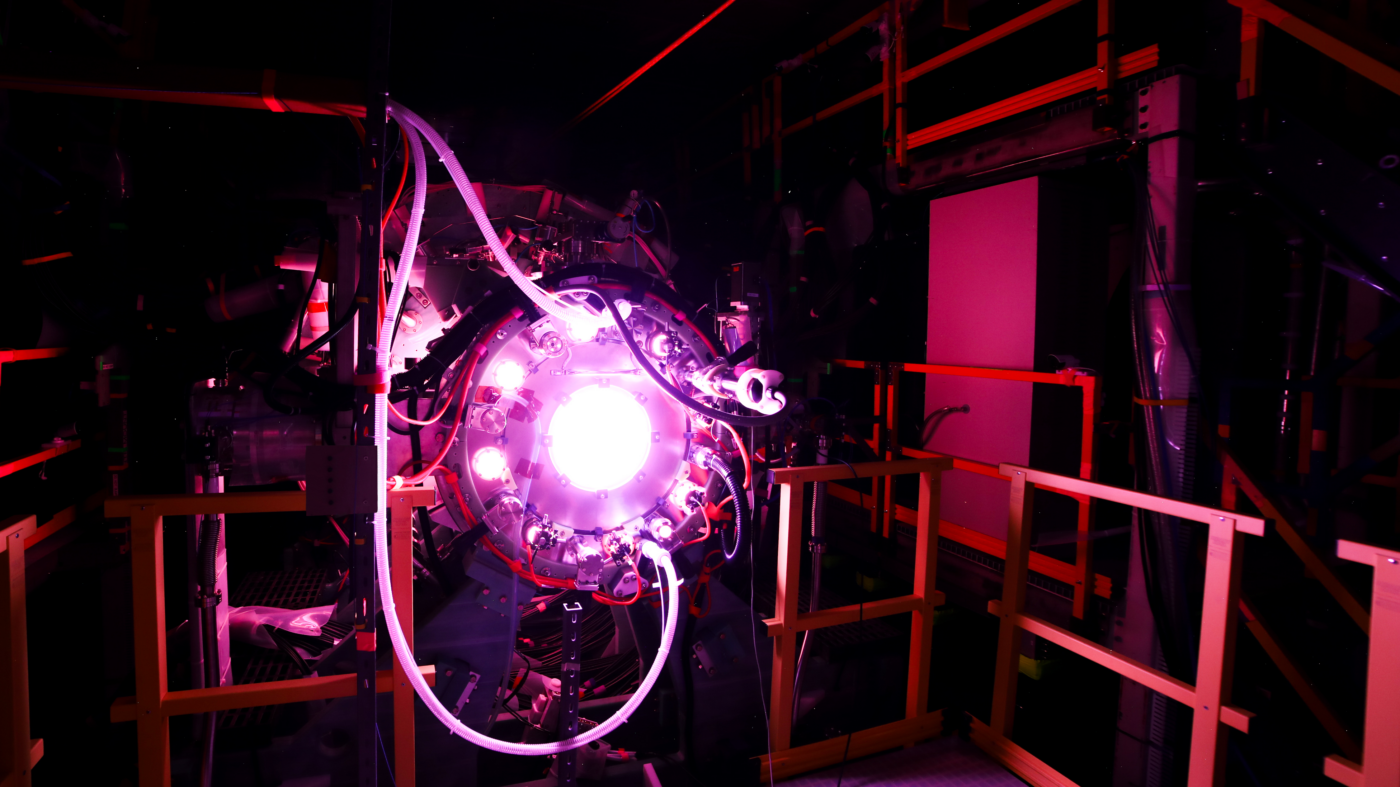
EVERETT, Wash. – Feb. 13, 2026 – Helion, a Washington-based fusion energy company, announced that its Polaris prototype has set new fusion industry benchmarks, becoming the first privately developed fusion energy machine to demonstrate measurable deuterium-tritium (D-T) fusion and achieve plasma temperatures of 150 million degrees Celsius (MºC). Both milestones mark significant breakthroughs in Helion’s vision to make commercially viable fusion energy a reality and are firsts for the private fusion industry.
“We believe the surest path to commercializing fusion is building, learning and iterating as quickly as possible,” said David Kirtley, co-founder and CEO of Helion. “We’ve built and operated seven prototypes, setting and exceeding more ambitious technical and engineering goals each time. The historic results from our deuterium-tritium testing campaign on Polaris validate our approach to developing high power fusion and the excellence of our engineering.”
Helion began operating its 7th-generation Polaris prototype at the end of 2024. This January, it became the first and currently only private fusion energy machine to use deuterium-tritium fuel, demonstrating the company’s ability to operate and show scaling across multiple fuels. Helion was also the first company to receive regulatory approval to possess and use tritium for the purpose of demonstrating fusion energy production. Achieving thermonuclear fusion using deuterium-tritium fuel is one step in Polaris’ testing program. The company will continue testing to reach optimal temperatures for deuterium-helium-3 fusion, a fuel Helion will use for commercial operations.
“I am impressed with our nation’s ingenuity and the pace at which we are de-risking our path to fusion commercialization,” said Jean Paul Allain, Associate Director for Fusion Energy Sciences in the Department of Energy’s Office of Science. “Seeing the data from the Polaris test campaign, including record-setting temperatures and gains from the fuel mix in their system, indicates strong progress. Our ability to get fusion on the grid requires approaches that enable rapid turnaround in design and testing, and these results reflect the growing capability of the U.S. fusion ecosystem.”
“I had the opportunity to review diagnostic data from Helion,” said Ryan McBride, an expert in inertial confinement fusion, pulsed power, and plasma physics, with experience as a Department Manager at Sandia National Laboratories and as a professor of nuclear engineering, electrical engineering, and applied physics at the University of Michigan. “It is exciting to see evidence of D-T fusion and temperatures exceeding 13 keV or 150 million degrees Celsius, and I look forward to seeing more progress.”
In achieving plasma temperatures of 150MºC in Polaris, Helion broke its own commercial fusion industry record for plasma temperatures of 100MºC set by its 6th-generation Trenta prototype. Within the fusion industry, 100MºC is considered the threshold plasma temperature for a commercially relevant fusion machine. Helion will continue to increase plasma temperatures in Polaris to demonstrate that it can reliably operate with deuterium-helium-3, which will be relevant for future Helion commercial operations.
“After reviewing the latest results from the Polaris prototype operating on D-T, I am proud of how far the field has come since the earliest FRC work at UW and Los Alamos,” said Dr. Alan Hoffman, a leading expert on FRC plasmas with over 40 years’ experience developing fusion devices. FRC research in the U.S. first began at Los Alamos, was continued at a private company, Math Sciences North West, and, due to encouraging results, proceeded to the construction of the Large S device at the University of Washington under funding from the U.S. Department of Energy, led by Dr. Hoffman. “I continue to see the technology scaling and Helion’s plasma energy recovery enabling this technology for commercial scale.”
With its latest technical accomplishments, Helion continues to set the pace for the fusion industry, creating a path to produce low-cost, carbon-free power from fusion for commercial use. In July 2025, Helion began building on the site of Orion, its first commercial machine, in Malaga, Wash., which will deliver electricity from fusion to the grid for Microsoft.
About Helion
Helion is a fusion energy company focused on generating zero-carbon electricity from fusion. Its mission is to build the world’s first fusion power plant, enabling a future with unlimited clean electricity. To keep up with the latest progress, follow Helion on LinkedIn, Instagram, Facebook, and X.